
Reducing candidate drop-off in India requires moving from manual “rationing” to an Agentic AI orchestration model that prioritizes real-time intent monitoring and personalized engagement. By solving for invisible intent during the notice period, organizations can turn drop-off rate into a predictable talent pipeline.
Who benefits from this:
- Talent Acquisition Leaders managing high-volume tech scaling.
- HR Directors at Global Capability Centers (GCCs) facing niche talent attrition.
- Recruitment Operations Managers looking to optimize Total Cost of Ownership (TCO).
- C-Suite Executives focused on revenue assurance through predictable hiring.
What You Will Learn
- How to identify invisible intent before a candidate reneges on an offer.
- The structural shift from Job Security to Skill Security in the Indian market.
- Tactical use of Agentic AI to automate 24/7 candidate support.
- How to design a Red Carpet onboarding journey that spans 0–90 days.
TL;DR
In India’s talent market, the biggest risk isn’t finding candidates—it’s getting them to join.
Ashby found an average 78% offer acceptance rate across 2021–March 2024, implying roughly 22% of candidates who reached offer did not accept. For talent teams, that makes conversion risk a critical issue even before post-offer engagement begins.
This article outlines seven fixes, from deploying Agentic AI bots for real-time intent tracking to transforming recruiters into strategic talent partners who influence business outcomes rather than just filling headcounts.
[This article combines public market benchmarks, insights from Hyreo re:Imagine 2026 sessions, and Hyreo’s product perspective on post-offer engagement.]
Candidate drop-off in India
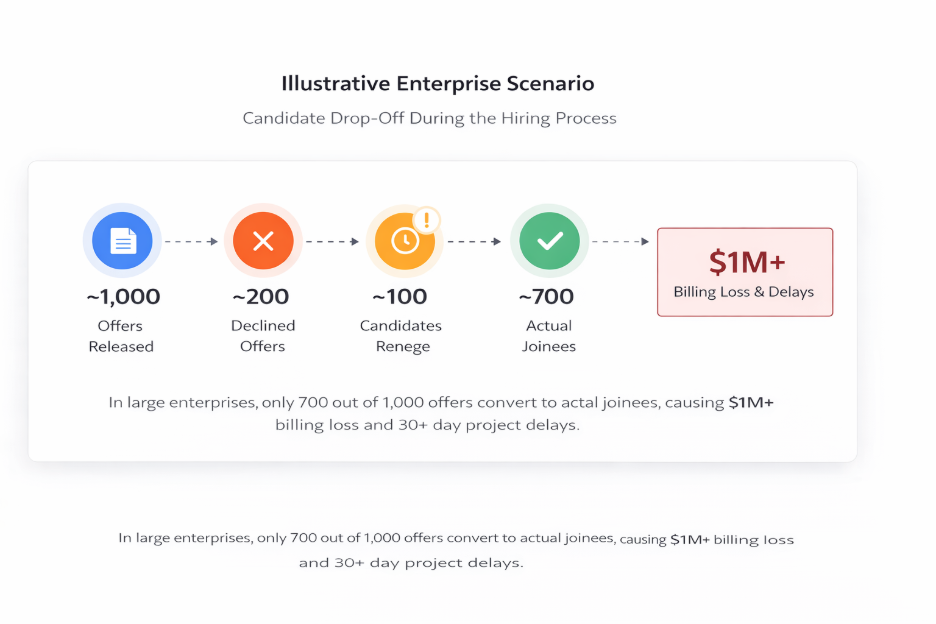
Candidate drop-off in India is defined by the Offer Decline & Renege cycle. In many enterprise hiring environments, talent teams see a double loss: some candidates decline at offer, while others accept and later renege during the notice period. Hyreo’s re:Imagine ‘26 sessions highlighted this post-offer window as one of the highest-risk parts of the funnel.
ETHRWorld cites Xpheno data saying offer acceptance rates for some Indian IT roles such as full-stack engineer, data engineer, data scientist, and DevOps engineer dropped to about 45%, from over 80%.
Why Drop-Off Happens
- Corporate Ghosting: After a proposal is accepted, many companies stop communicating, leaving the candidate in an emotional vacuum.
- Invisible Intent: Candidates often shop around during long notice periods without providing clear signals of their true motivation.
- The Plenty Paradox: Recruiters have more candidate data than ever, but far less time and attention to interpret it meaningfully.
- Traditional Checklist Onboarding: Relying on “laptop and videos” instead of building a human connection.
According to LinkedIn, 66% of applicants accept offers because of a positive hiring process, while 26% reject offers due to lack of communication. As Arun Satyan noted at re:Imagine ‘26, recruiting today is rich in applicant data but constrained by the scarcity of attention, time, and intelligence. ______________________________________________________________________
7 Strategic Fixes to Reduce Drop-Off
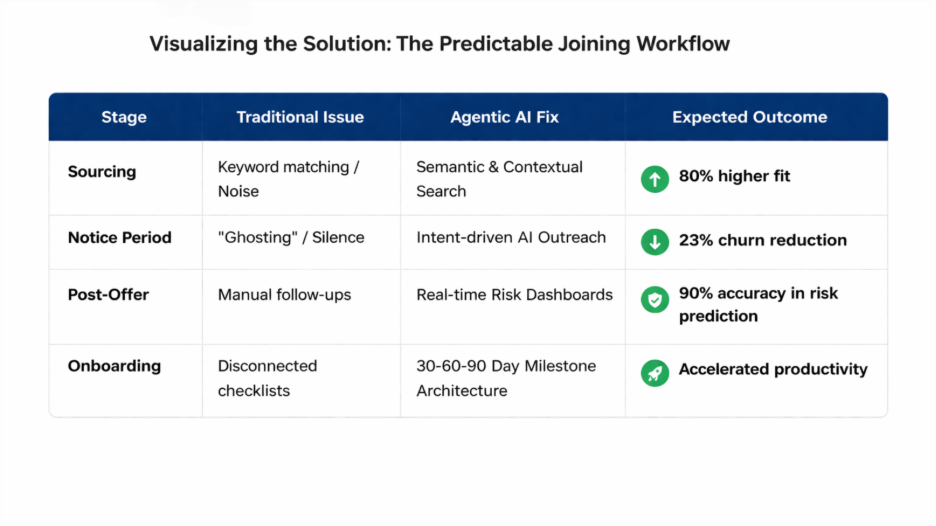
Hiring stage | Common drop-off risk | Traditional response | Better approach |
Offer release | Candidate declines | Manual persuasion | Stronger value communication and faster clarification |
Notice period | Candidate reneges | Periodic recruiter check-ins | AI-led intent tracking and mapped engagement journeys |
Pre-joining | Candidate goes silent | Reactive follow-up | 24/7 FAQ support and status visibility |
Onboarding | Early disengagement | Checklist-based onboarding | Structured Red Carpet onboarding with clear ownership |
1. Deploy Agentic AI for Intent Monitoring
Traditional ATS systems are reactive. To reduce drop-off, recruiters must use Agentic AI platforms like Hyreo to autonomously monitor candidate pulses.
- How it works: AI agents conduct voice and chat-based outreach to gauge joining propensity based on real-time signals.
- The Fix: Use a Joining Propensity Indicator to rank candidates at risk of not joining, allowing recruiters to intervene only where necessary.
2. Transition from Keyword Search to Semantic Matching
Recruiters often rely on surface-level matching, which returns high volume but low relevance.
- The Fix: Shift to semantic search and contextual matching. This identifies candidates whose career trajectory and X-shaped capabilities—domain, technology, and business acumen—align with the role, increasing their long-term commitment.
3. Replace Ghosting with Mapped Engagement Journeys
The notice period is when the most reneges occur. Long gaps between final interviews and offers increase the risk of losing candidates.
- The Fix: Implement a customized engagement journey mapped to 15-30-60-90 day milestones. This includes sending day-in-the-life content, leader messages, and peer connect invites. LinkedIn suggests adding more touchpoints to keep candidates engaged.
4. Provide a Dedicated Candidate App Interface
Candidates expect a consumer-grade experience similar to apps like Swiggy.
- The Fix: Offer a unified candidate-facing interface providing end-to-end visibility of the hiring status in real-time. Transparency builds trust and reduces the likelihood of the candidate entertaining other offers.
5. Deploy 24/7 Multi-Channel FAQ Support
Recruiter bandwidth is a major bottleneck. Candidates often drop off because simple questions about compensation or location go unanswered for days.
- The Fix: Use NLP-driven conversational agents on WhatsApp and Voice to provide 24/7 self-service support. One of our customers recently saw a 44% reduction in issue resolution time using this model.
6. Solve the Handover Gap with Structured Onboarding
Drop-off doesn’t stop on Day 1. Early attrition is often caused by poor coordination between TA, HR, and IT.
- The Fix: Design a Red Carpet onboarding model that ensures IT assets are ready and a buddy is assigned before the candidate walks in.
7. Transform Recruiters into Strategic Talent Partners
If recruiters remain order takers, they cannot influence a candidate’s decision-making process.
- The Fix: Equip recruiters with predictive analytics so they can move away from manual filtering toward becoming business advisors who influence workforce planning and location strategy.
Metrics You Must Track
To move from spray-and-pray to predictable outcomes, talent leaders should monitor:
- Joining Propensity Score: Predictive accuracy of who will actually show up.
- Candidate NPS (Net Promoter Score): Real-time sentiment collected during the offer stage.
- Offer-to-Joining Ratio: The ultimate measure of conversion success.
- Issue Resolution TAT: How fast candidate queries are resolved via AI vs. human.
Mini Case Study: Hyreo Post-offer solution reduced candidate drop-offs for an ICT Japanese firm
Challenge: A company sought to enhance candidate engagement and experience during the critical post-offer stage to reduce candidate decline rates.
Solution: Implementation of Hyreo’s Post-Offer Solution (part of the Convert X bundle), focusing on maintaining a seamless candidate journey through automated communication and engagement tools.
Result:
- 44% reduction in candidate query resolution time.
- Predictive accuracy for candidate joining propensity surged to 82%, allowing for more reliable hiring outcome forecasts.
Conclusion
India’s unique demographic and digital infrastructure have created a “Goldilocks” opportunity for enterprises to become global innovation hubs. However, realizing this potential requires a total redesign of the hiring experience, especially the post-offer experience. By leveraging Agentic AI to solve for candidate intent and moving toward a seamless post-offer journey, organizations can finally close the 90-day black hole and build a resilient, committed workforce.
Ready to stop the “Ghosting Phenomena” in your hiring funnel? Reimagine your talent strategy with Hyreo: Book a Demo.
FAQ
Q: What is the most common reason for candidate drop-off in India?
A: The “Ghosting Phenomena” where communication stops post-offer, combined with “invisible intent” where candidates shop for better offers during long notice periods.
Q: How can AI help in reducing candidate reneges?
A: AI monitors “joining propensity” through 24/7 conversational engagement, allowing recruiters to receive real-time alerts when a candidate’s sentiment or intent signals a risk.
Q: Does improving candidate experience actually impact the bottom line?
A: Yes — a better candidate experience directly improves the bottom line by increasing offer acceptance, reducing drop-offs, and lowering overall hiring costs